Your coding agent already writes the code running in production: features, endpoints, business logic, all of it. If you’re comfortable with that, you’ve already accepted the risk profile of agent-written code. Applying a security fix isn’t a different category of risk than that.
So why does it feel different? Not because the agent is less trustworthy here. Because a security fix patches something your existing tests didn’t catch. That’s the entire reason it showed up as a finding instead of a failing test. Security-relevant behavior has thinner test coverage than feature behavior, structurally, for every team, regardless of who writes the fix. Here’s what happens when the agent applies a fix, and where that gap gets closed.
What “apply the fix” actually means
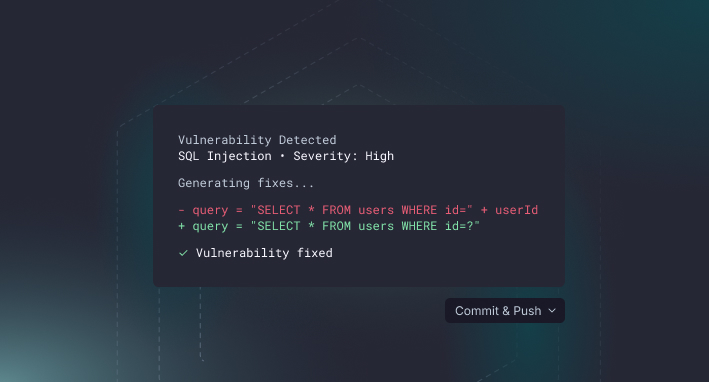
StackHawk’s agent doesn’t push anything to CI. It doesn’t merge. It doesn’t touch your main branch. What it does:
- Finds a vulnerability in your running application (not a guess from reading code, an observed behavior).
- Proposes and applies a patch, locally, in your working tree, and rebuilds/deploys locally.
- Rescans the running app to confirm the specific vulnerability is closed.
That’s it. The patch exists as a diff on your machine, same as any change you or your coding agent would make by hand. Nothing has shipped anywhere.
The gate you already trust is still the gate
Once the fix is applied locally, it goes through the exact same path every other code change goes through at your company:
- Code review → someone still looks at the diff.
- Integration tests → your existing test suite still runs.
- CI → still the last checkpoint before anything ships.
None of that changes because an agent wrote the patch instead of a human. The fix doesn’t get a shortcut through your pipeline. It gets in line behind it, like everything else.
If the fix introduces a regression, your integration tests catch it in the same place they’d catch a regression from a human-written change. The agent isn’t operating with less scrutiny than your team. It’s operating with exactly the same scrutiny, applied at the same point it always has been.
Two different questions, answered by two different things
It’s worth separating what StackHawk’s rescan confirms from what your test suite confirms, because conflating them is where the real trust gap hides.
- “Is the vulnerability actually fixed?” That’s what the rescan answers. StackHawk sends the same real request that triggered the finding and confirms the response no longer exposes it.
- “Did the fix break something else in my app?” That’s not a security question, and StackHawk doesn’t claim to answer it. That’s what code review and your integration tests are for, same as they’ve always been.
The agent closing the security gap and your pipeline confirming the app still works are two separate checks. Neither replaces the other. That’s by design; a patch that closes a vulnerability but breaks checkout is still a bad patch, and your existing tests are what catch that, not StackHawk.
Why the rescan matters more than the review gate
The code review and CI gates are unchanged. The interesting part is the rescan, because it’s covering the one thing those gates were never built to catch.
Your integration tests were written against expected behavior: does checkout work, does login work, does the API return the right shape. A vulnerability, almost by definition, is behavior nobody wrote a test for, because nobody knew to look for it. That’s true whether a human or an agent writes the fix. So the rescan isn’t an extra layer of caution added because an agent is involved. It’s the piece that specifically covers the blind spot every team has in this category, agent or not.
That’s the actual case for letting the agent apply the fix: not that it’s being watched more closely than usual, but that the one gap in your coverage, the security-specific one, now has something checking it that wasn’t there before.
Try it on one finding
You don’t have to flip this on for your whole backlog. Pick one finding from your last scan, let the agent apply the fix, and watch it move through your normal review process exactly like any other pull request would. Nothing about your pipeline needs to change for you to find out whether this works for your team.
A note on scope: this describes local application of a fix followed by your existing review and CI process. It doesn’t cover teams who’ve chosen to auto-merge on green CI; if that’s your setup, the same principle applies, just one step further down your existing pipeline.