
Finding was the old job.
Now it’s fixing before it ships.
Contact StackHawk
Let us help you figure out if StackHawk is right for your needs.
For more information about how StackHawk handles your personal data, please see our Privacy Policy.
Proven at a national healthcare firm
%
%
Time to get there.
The threat model has changed
You can’t answer exponential finding with linear fixing.
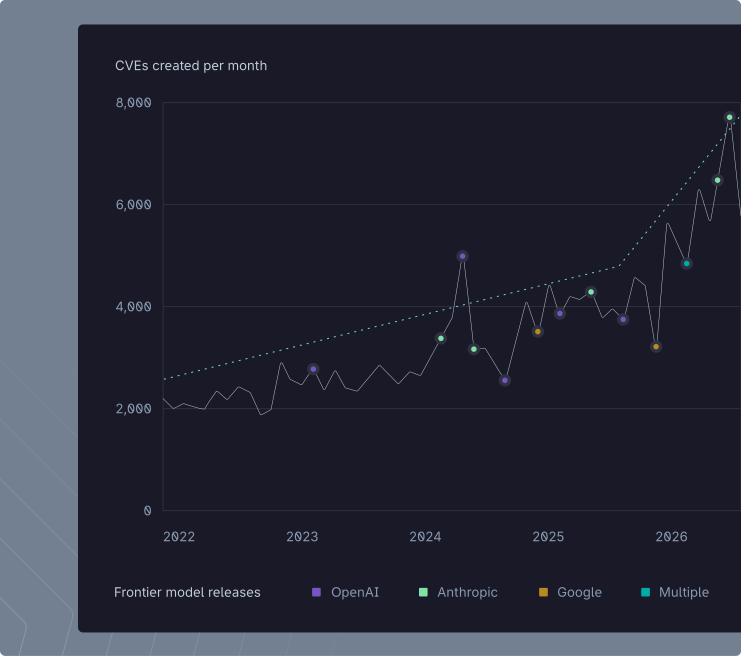
Low severity isn’t low risk
Mythos-class models chain low-severity findings into serious attack paths — severity alone can’t drive prioritization anymore.
AI catches what humans miss
Research shows multi-step attack chains that traditional reviews miss. StackHawk tests in-session and catches them before they ship.

Backlog is risk, not overhead
An unmanaged backlog is risk sitting on the books. The shift: fix everything at commit, not by severity.
The board and execs need a plan
The testing doesn’t belong to your team anymore. That’s the point.
The exposure is growing
Mythos-class models are surfacing tens of thousands of vulnerabilities companies didn’t know they had. In regulated industries, that means diverting real resources to fix them, fast.

Fix more without hiring more
Most AppSec programs can find. Few can fix without a plan becoming a headcount problem. StackHawk is that plan: it fixes vulnerabilities inside the agent as code ships, so the backlog doesn’t outrun the team.
How it works inside the agent session
Contact StackHawk
Let us help you figure out if StackHawk is right for your needs.
For more information about how StackHawk handles your personal data, please see our Privacy Policy.
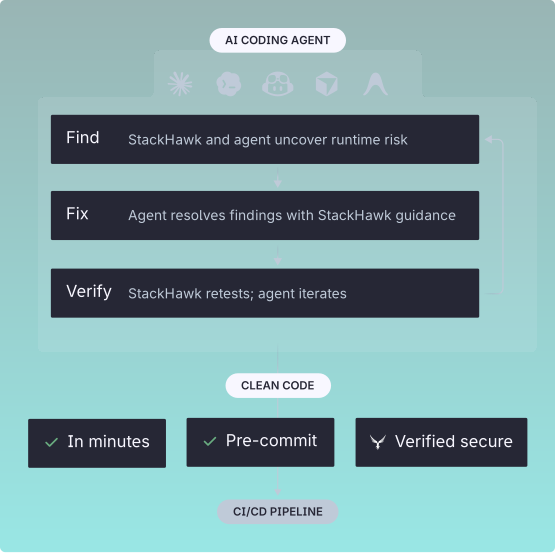
Agent completes a feature
Wingman works inside Claude Code, Cursor, or Copilot—no new tool or context switch.

Wingman boots and tests
Wingman auto-configures, starts the app locally, and tests it with real HTTP requests.

Finds, fixes, and verifies
The agent fixes vulnerabilities and verifies them before code leaves the coding session.

A clean signal, verified
CI gets a clean signal; security gets an attestation for boards, audits, and renewals.

Real results from a single app
90
$100
What Each Side Actually Gets
Security leadership
Velocity
Security stops being the reason a release slips.
Risk exposure
The backlog shrinks instead of growing.
Proof and reporting
An evidence trail that survives being asked twice.
Cost and headcount
Coverage scales with AI-generated code—without growing headcount.
Engineering leadership
Velocity
Ship on schedule with no new gate or context switch.
Risk exposure
Vulnerabilities are fixed in the same session they’re introduced.
Proof and reporting
A clean CI signal your team can trust.
Cost and headcount
No new hires to keep pace with your agents.
StackHawk Scale
Built for the Security Team
Attack surface discovery
Know which apps, APIs, and endpoints exist before rollout — your rollout order becomes a risk decision, not a guess.
Coverage observability
See what’s tested, how often, and what’s fixed, by team — an exportable, board-ready view of the whole program.

Continuous attestation
Every agent-loop commit records testing and issues closed before merge—built-in SOC 2 evidence and a FedRAMP paper trail.
Make Your Program Mythos-Ready.
Contact StackHawk
Let us help you figure out if StackHawk is right for your needs.
For more information about how StackHawk handles your personal data, please see our Privacy Policy.