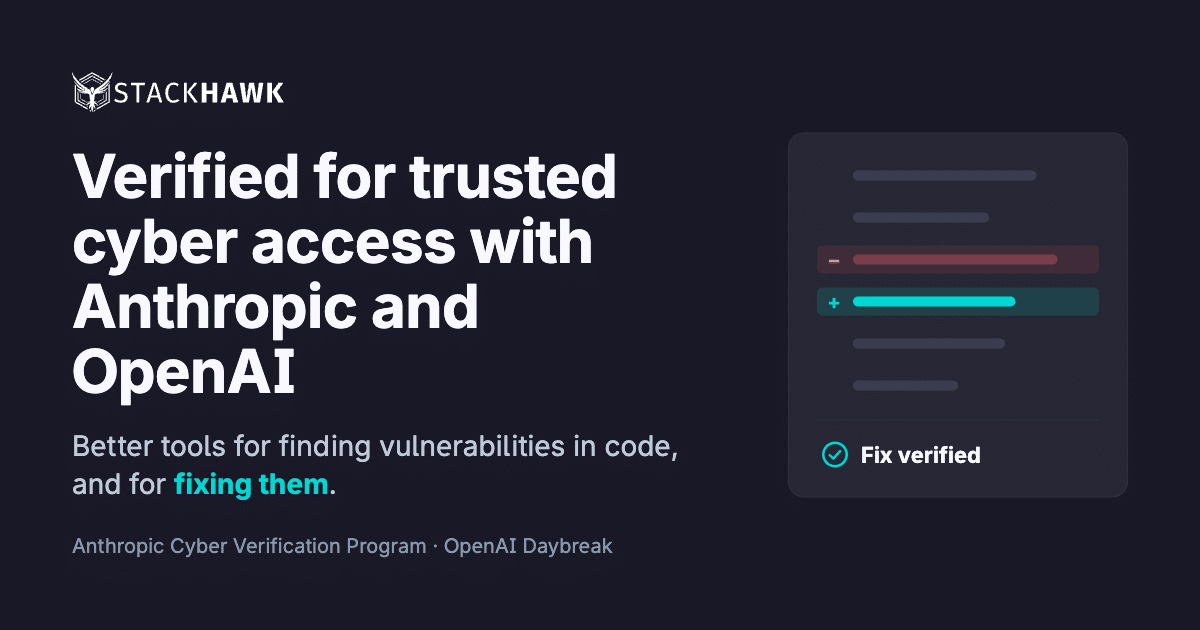
Anthropic and OpenAI have both approved StackHawk for trusted cyber access. With Anthropic it’s the Cyber Verification Program. With OpenAI it’s Daybreak, which is what they call their Trusted Access for Cyber program.
I’m proud of this one. Getting in takes more than a form. Both companies check who you are and what you plan to do with the access, and they keep watching after you’re approved.
For us it means better tools for the work we care about most, which is finding vulnerabilities in code and then FIXING them.
What Anthropic’s Cyber Verification Program and OpenAI’s Daybreak are
Out of the box, frontier models are cautious about security work. Anthropic says its generally available models block most cyber work. OpenAI runs its mainline models with standard safeguards unless your organization has been approved for more.
I think that hurts defenders. Security has always been dual use, and the reasoning that helps me understand how a bug gets exploited is the same reasoning I need to fix it. Locking it down slows down the people doing the fixing.
Both companies do offer defenders a way to get vetted. You apply, prove who you are, explain the defensive work you do, and agree to closer monitoring. Once you’re approved, the models stop refusing a lot of legitimate work, like checking whether a vulnerability is real or whether a patch actually fixes it.
We’re happy to be part of it. Helping defenders get the tooling and capabilities they need to do their jobs is the work we want to be doing.
Why it matters for fixing code
Nobody in AppSec is short on findings. Most teams I talk to have a backlog that’s been around longer than some of their engineers. Fixes that actually work are much harder to come by.
Fixing a vulnerability properly means understanding how it gets exploited, and verifying the fix means running the attack again. That’s the kind of work that trips a safety classifier, because a defender doing it carefully looks a lot like an attacker getting started.
Fixing is the part we care most about at StackHawk. Wingman runs a scan, fix, and verify loop inside the coding agents engineers already use, including Claude Code and Codex. Since June it has fixed about 12,000 vulnerabilities. When we say fixed, we mean we checked.
What changes for customers
Right now this access lives with our own security research and engineering team. Both programs are built for an organization’s internal defensive work, so nothing about how your scans run changes on Monday.
It changes how we build. We use these models to validate findings, test fixes against real attack paths, and pressure-test the detection and remediation logic before it ships in StackHawk. Less time arguing with refusals means more time on the stuff you actually notice.
Both programs are moving fast. Anthropic folded its Project Glasswing access into an expanded CVP in October, and OpenAI has expanded its program several times since launching it in February. Being verified with both puts us in a good spot for whatever comes next, and we plan to bring as much of it to customers as the programs allow.
We’ll share what we learn as we put this to work.
FAQ
What is Anthropic’s Cyber Verification Program?
It’s Anthropic’s program for vetted security organizations that need Claude for defensive work its cyber safeguards would otherwise block. Organizations apply, get verified, and agree to data retention so Anthropic can watch for misuse.
What is OpenAI Daybreak?
Daybreak is OpenAI’s Trusted Access for Cyber program. Approved organizations get fewer refusals on supported models for authorized defensive work on systems they own or are allowed to test.
Why do AI models refuse security work?
Security work is dual use. The reasoning that helps a defender understand and fix a vulnerability is the same reasoning an attacker wants, so frontier models block most cyber work by default.
Does this change how StackHawk scans work?
No. The access sits with StackHawk’s security research and engineering team, and it changes how we build and validate what ships.