Last updated November 20, 2026
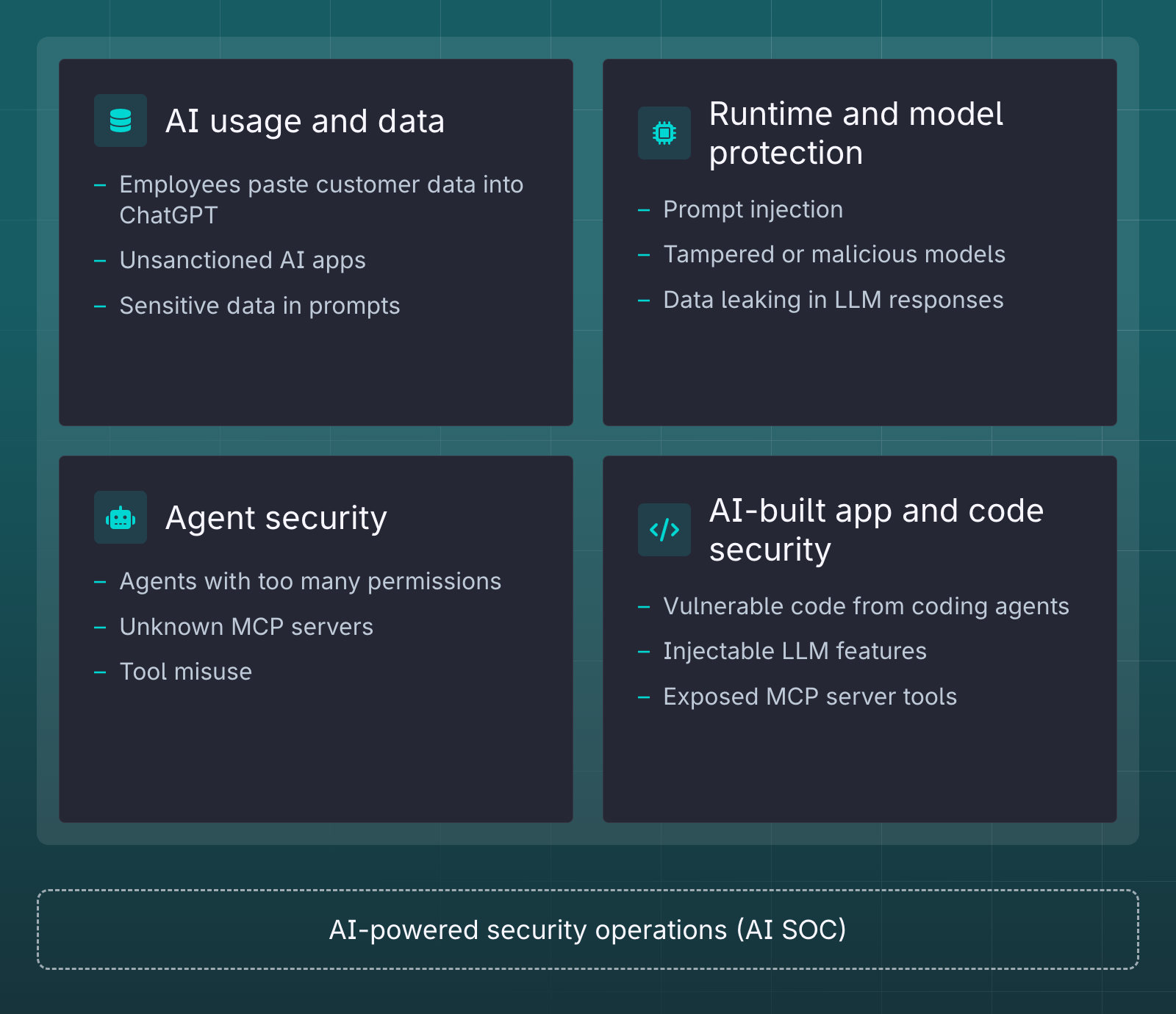
Ask five vendors what an AI security platform is, and you'll get five answers. One means stopping employees from pasting customer data into ChatGPT. Another means a firewall in front of your LLM feature. A third means an AI SOC that triages alerts for you. AI-generated code also needs application security testing.
So this list of the best AI security platforms for 2026 is organized by the problem each one solves, not by a single ranking. Find the row that matches your risk, then read that category.
At a glance
| Platform | Category | Best for | Pricing model |
|---|---|---|---|
| Cyera | AI usage and data | Data-centric AI governance across cloud and SaaS | Custom quote |
| Microsoft Purview DSPM | AI usage and data | Organizations standardized on Microsoft 365 Copilot | Microsoft 365 E5 or Purview Suite license |
| Prompt Security (SentinelOne) | AI usage and data | Shadow AI and code assistant usage across the workforce | Sales-led |
| Nightfall | AI usage and data | Inline DLP for ChatGPT, copilots, and browser AI tools | Per user per year; 7-day proof of value |
| Grip Security | AI usage and data | Shadow AI discovery tied to identities | Sales-led; 30-day try-and-buy |
| Lakera (Check Point) | Runtime and model protection | Prompt attack protection for LLM apps and agents | Free self-serve start; enterprise via sales |
| Palo Alto Networks Prisma AIRS | Runtime and model protection | Model scanning through runtime in one suite | Sales-led |
| Cisco AI Defense | Runtime and model protection | Network-level guardrails without SDK changes | Sales-led |
| HiddenLayer | Runtime and model protection | Model supply chain scanning | Sales-led |
| Zenity | Agent security | Governing enterprise agents in Copilot Studio, Agentforce, and similar | Sales-led |
| Noma Security | Agent security | Inventory of agents, models, and MCP servers | Sales-led |
| Straiker | Agent security | Red teaming plus runtime guardrails for agents | Sales-led |
| StackHawk | AI app and AI-generated code | Runtime testing inside coding agents, plus LLM and MCP endpoints | Wingman $10/user/mo, 14-day trial; Scale via sales |
| Checkmarx One | AI app and AI-generated code | Enterprise AppSec suite with coding agent hooks | Custom quote |
| Snyk | AI app and AI-generated code | SAST and SCA inside agent workflows via MCP | Free tier; Team from $25/mo; Evo requires Enterprise |
| GitHub Advanced Security | AI app and AI-generated code | GitHub-native teams | Code Security $30 per active committer/mo |
| OpenAI Codex Security | AI app and AI-generated code | ChatGPT orgs wanting validated code findings | Research preview on eligible ChatGPT plans; scans billed by token |
| Claude Security | AI app and AI-generated code | Claude Enterprise customers | Public beta on Enterprise plans; scans billed at token cost, no platform fee |
| CrowdStrike Falcon | AI-powered SecOps | Endpoint-led SOC with AI triage | Falcon Go endpoint bundle from $7.99/device/mo |
| SentinelOne Singularity | AI-powered SecOps | Unified endpoint, cloud, and identity SOC | Singularity Complete from $179.99/endpoint/yr |
| Darktrace | AI-powered SecOps | Behavioral anomaly detection | Sales-led |
What Is an AI Security Platform?
An AI security platform is a product that reduces risk created by AI or uses AI to reduce security risk. In 2026, the phrase covers three different jobs.
Security for AI protects your organization's AI adoption: employee use of generative AI, the AI models and large language models you deploy, and the permissions you give agentic AI. Shadow AI discovery, sensitive data in prompts, model integrity, and prompt injection all live here.
AI-powered security is the AI SOC: threat detection and response tools that use machine learning and LLM assistants to triage alerts faster. Useful, but it's a different buying decision for security teams, so it gets one short section here.
Securing AI-built software covers the code, AI applications, and MCP servers that coding agents produce. If you're building AI features yourself, our guide to AI security best practices covers the developer side in more depth.
How We Chose These Platforms
We publish this list at StackHawk and include our platform in one category: AI application and AI-generated code security. We didn't rank ourselves first overall, because "best AI security platform" isn't a single contest. A data governance tool and a runtime tester solve different problems.
Here's what we looked at in each category:
- Coverage of the real risk. Does the platform address the risks in the OWASP Top 10 for LLM Applications that fall in its category, such as prompt injection, sensitive information disclosure, or excessive agency?
- Where it runs. Browser, network, gateway, CI/CD, or inside the coding agent. Check whether that deployment model covers your traffic and fits your workflow.
- Evidence. We only included capabilities that each vendor documents on its own site.
- Pricing transparency. We note public pricing where it exists and "sales-led" where it doesn't.
Verify current product scope, pricing, and acquisition status before buying.
AI Usage and Data Security Platforms
These platforms help answer: what AI tools are our people using, and what sensitive data is going into them? Shadow AI discovery and data leakage prevention are the core jobs.
Cyera
Best for: teams that want AI governance built on top of data security posture management (DSPM).
Cyera's platform spans data, identity, and agents. Its product set includes DSPM, Omni DLP, Cyera Identity for discovering non-human identities and governing what they can reach, and Agent Guardian for controlling what agents can see and do. The data-first approach suits organizations whose main AI risk is sensitive data reaching models it shouldn't. Pricing is quote-based.
Microsoft Purview Data Security Posture Management
Best for: organizations already standardized on Microsoft 365 and Copilot.
Purview's DSPM includes AI observability, an inventory of AI apps and agents with activity in the last 30 days. Its activity explorer shows AI interactions, including prompts and responses that contained sensitive information and any DLP rule matches. Coverage extends to third-party AI apps such as ChatGPT Enterprise. It requires a Microsoft 365 E5 or Microsoft Purview Suite license. Check your existing license before budgeting for it.
Prompt Security (SentinelOne)
Best for: inventorying shadow AI and code assistant usage across employees and developers.
SentinelOne announced an agreement to acquire Prompt Security on August 5, 2025, and Prompt Security is now listed as part of the SentinelOne platform. It inventories AI tools and code assistants in use, including unsanctioned ones, redacts sensitive data in AI interactions, and maps agents and MCP servers in the environment. It also covers homegrown AI apps with a real-time AI firewall.
Nightfall
Best for: inline data loss prevention for AI tools employees already use.
Nightfall enforces policy inline before data leaves and targets data going out through personal ChatGPT accounts, unmanaged copilots, and browser AI tools. Coverage spans SaaS, endpoint, and email. Pricing is per user per year, and instead of a self-serve trial, Nightfall offers a free 7-day proof of value.
Grip Security
Best for: finding shadow AI through the identity layer.
Grip builds an inventory of AI and SaaS apps, including ones outside SSO, and links each to the identities using it. You can tie an AI tool back to an employee and revoke access. That helps when the question is "who signed up for what" rather than "what data went where." Grip offers a 30-day no-cost try-and-buy.
AI Runtime Protection and Model Security
If you ship an LLM feature, someone will try to make it ignore its instructions. These platforms sit in front of or around your AI models and AI agents to catch prompt injection, data leakage, and malicious models. They complement testing: a guardrail blocks attacks in production, while testing finds the flaw before release. If you want the testing side, here's how to test LLM features in your existing AppSec workflow.
Lakera (Check Point)

Best for: runtime protection against prompt attacks in LLM apps and agents.
Check Point announced an agreement to acquire Lakera on September 16, 2025. Lakera's products now include AI Agent Security for runtime protection of AI applications, Workforce AI Security for employee use, and AI Red Teaming. Developers can start for free on the self-serve platform.
Palo Alto Networks Prisma AIRS
Best for: teams that want model scanning, red teaming, and runtime protection from one vendor.
Palo Alto Networks completed its acquisition of Protect AI on July 22, 2025, and folded it into Prisma AIRS. The suite combines model scanning, posture management, AI red teaming, runtime protection, and AI agent security. The model security piece scans models for tampering, malicious scripts, and deserialization attacks, which matters for supply chain security if you pull open-weight models into your pipeline.
Cisco AI Defense

Best for: guardrails that don't require code changes.
Cisco AI Defense discovers AI workloads, models, and applications, validates models through algorithmic red teaming, and enforces runtime guardrails embedded in the network, without agents or libraries in your app. Platform teams can apply protection without asking every product team to adopt an SDK.
HiddenLayer
Best for: model supply chain security.
HiddenLayer covers AI discovery, scanning of third-party and proprietary models for hidden risks, attack simulation, and a runtime firewall for generative and agentic AI applications. The supply chain focus is the reason to look at it. If your teams download models from public hubs, scanning those artifacts before deployment closes a gap guardrails alone don't cover.
AI Agent Security and Governance
Agentic AI changes the threat model. An agent with access to email, a CRM, and a few MCP tools can do real damage if it's manipulated, which is exactly what OWASP calls excessive agency. Agent security platforms inventory AI agents, govern their permissions, and watch what they do in real time. If you build your own MCP servers, start with our guide to securing MCP servers.
Zenity
Best for: governing enterprise agents built on low-code and SaaS agent platforms.
Zenity focuses on deciding what AI agents can and can't do. It supports a long list of agent platforms, including Copilot Studio, Salesforce Agentforce, ChatGPT Enterprise, and Amazon Bedrock AgentCore. It adds AI security posture management, observability, and AI detection and response.
Noma Security
Best for: a single inventory of agents, models, and MCP servers.
Noma discovers agents, models, MCP servers, and tools across cloud, SaaS, and developer environments. It adds posture management, runtime detection, and red teaming that probes for prompt injection, jailbreaks, and data leakage. Enforcement works through agent hooks, MCP gateways, AI gateways, and SDKs, so it can fit whichever control point you already have.
Straiker
Best for: pairing agent red teaming with runtime guardrails.
Straiker splits the job into three products. Discover AI handles agent and MCP visibility, and Ascend AI continuously red-teams agents across tools and MCP servers. Defend AI adds runtime guardrails against prompt injection, data leakage, and tool manipulation.
AI Application and AI-Generated Code Security
This is the AI application security category: software that AI builds, and the AI features inside it. Coding agents like Claude Code, Cursor, GitHub Copilot, and Codex produce code that needs security testing. That code often ships LLM features and MCP servers of its own. Securing it means testing the code and the running app, ideally before the agent marks the task done. For the developer habits that help, see our guide to AI code security.
StackHawk
Best for: teams shipping AI-built apps or AI features who want runtime evidence that a vulnerability is fixed.
Our platform brings runtime security testing (DAST) inside the coding agent loop. Wingman scans the running app your coding agent just built, hands the finding back to the agent, and rescans to check whether the finding still reproduces. That's the Find, Fix, Verify loop, closing the gap between finding a vulnerability and fixing it.
What it covers:
- Coding agents: Wingman works in Claude Code, Codex, Cursor, GitHub Copilot, and Antigravity through our agent skills.
- Logic flaws: broken access control and business logic bugs, where the code looks fine, but the app behaves incorrectly, alongside 150+ vulnerability types like SQL injection and XSS.
- LLM features: LLM security testing checks your app for prompt injection, sensitive data leaks, and output handling flaws as part of runtime testing in CI/CD.
- Remote MCP servers: for MCP server security testing, add an MCP block under jsonRpcConf in
stackhawk.yml,and StackHawk discovers the tools available over Streamable HTTP, then tests for injection, SSRF, and data exposure.
Pricing: Wingman is $10 per user per month with unlimited apps and 50 scans per user per month, with a 14-day free trial and no credit card. Scale, for every developer and app, is sales-led.
Limits: Our platform doesn't govern employee AI usage or stop data leaving through ChatGPT, it isn't an inline LLM firewall in production, and it isn't a SOC tool. Pair it with tools from the categories above for those jobs.
Checkmarx One
Best for: enterprises that want one AppSec suite with hooks into coding agents.
Checkmarx One is an application security platform that combines SAST, SCA, secrets, IaC, and container scanning. Its Developer Assist is built to help developers and AI coding agents detect, remediate, and verify security issues, and it connects to assistants through Checkmarx MCP. Checkmarx One uses quote-based package pricing. Developer Assist separately advertises a free trial; confirm the included products and terms when evaluating it.
Snyk
Best for: SAST and dependency scanning inside AI agent workflows.
Snyk Studio uses Snyk's MCP server to embed security checks into agentic coding workflows, and Snyk names assistants like Cursor, Claude, GitHub Copilot, and Windsurf as integrations. The Free plan includes SAST, SCA, IaC, and container scanning with usage limits, and Team starts at $25 per month. Those plans do not include Evo capabilities such as coding-agent security, which require an Enterprise Platform Subscription.
GitHub Advanced Security
Best for: teams whose code and pipelines already live in GitHub.
GitHub now sells security as two add-ons. Code Security costs $30 per active committer per month and includes CodeQL code scanning, dependency review, and Copilot Autofix. Autofix generates fix suggestions for CodeQL alerts and doesn't require a Copilot subscription. Secret Protection is sold separately.
OpenAI Codex Security
Best for: organizations on ChatGPT that want AI-validated code findings.
Codex Security is a research preview for ChatGPT Enterprise, Edu, Business, and Pro. It uses a threat model to guide its analysis of a repository, tries to reproduce each potential vulnerability in an isolated environment, and proposes a patch for human review. We covered where Codex Security fits next to DAST in a separate post.
Claude Security

Best for: Claude Enterprise customers.
Claude Security is in public beta on Enterprise plans. It scans codebases, runs every finding through multi-stage verification before surfacing it, and lets you move from a finding into a Claude Code session to review the fix. If you're weighing it against the built-in /security-review command, see our comparison of Claude Code's security review options.
Where these tools overlap, and where they don't. Codex Security and Claude Security read source code and validate their findings; we test the running app with StackHawk. A code-reading tool can miss an access control bug or misconfiguration that only shows up in the deployed app. A runtime tester won't flag a vulnerable function the running app doesn't expose yet. Combine code analysis and runtime testing when you need both kinds of coverage.
If you want to see the runtime half on your own code, try Wingman free for 14 days, no credit card required.
AI-Powered Security Operations (Briefly)
If you searched for AI security platforms, meaning "AI that defends us," you're looking at AI cybersecurity for the SOC: AI-driven threat detection, investigation, and response. The following platforms combine endpoint or SOC security with AI capabilities:
- CrowdStrike Falcon: Charlotte AI, an agentic SOC and Next-Gen SIEM, plus AI Detection and Response (AIDR) for securing AI use from agents to models to prompts. Public pricing starts with the Falcon Go endpoint bundle at $7.99 per device per month, and there's a 15-day free trial of Falcon Prevent. Check which tier includes the AI SOC features you need.
- SentinelOne Singularity: unifies endpoint, cloud, and identity security, with Purple AI for investigation and AI SIEM. Public pricing starts at $179.99 per endpoint per year for Singularity Complete, which covers endpoint and cloud workloads. Commercial adds identity detection and response, and Enterprise includes the AI SOC analyst.
- Darktrace: Adaptive AI that learns your environment's operational patterns, and a newer Darktrace / SECURE AI product for AI systems and agents.
CrowdStrike, SentinelOne, and Darktrace now also offer products that protect AI systems. They're still AI SOC platforms first.
How to Choose an AI Security Platform
Start with the risk you actually have, not the category with the most buzz. Use the following mapping to start a shortlist:
| If your risk is... | Start with | Examples from this list |
|---|---|---|
| Employees pasting sensitive data into AI tools | AI usage and data security | Nightfall, Purview, Prompt Security |
| Unknown AI apps and agents in use | Shadow AI and agent discovery | Grip, Noma, Cyera |
| Our LLM feature can be prompt-injected | Runtime protection plus pre-release testing | Lakera, Cisco AI Defense, StackHawk |
| Agents with too many permissions | Agent security and governance | Zenity, Straiker, Noma |
| AI writes most of our code | AppSec inside the agent loop | StackHawk, Snyk, Checkmarx, GitHub |
| Alert volume in the SOC | AI-powered SecOps | CrowdStrike, SentinelOne, Darktrace |
Then pressure-test the shortlist of AI security platforms:
- Map to a framework. The NIST AI Risk Management Framework, released in January 2023 with a Generative AI Profile added in July 2024, gives you a voluntary structure for governing AI risk. MITRE ATLAS catalogs real adversary techniques against AI systems. Use them to find the gaps your current stack leaves open.
- Check where enforcement happens. Browser extensions, network gateways, SDKs, and agent hooks each cover different traffic. A tool that can't see your traffic can't protect it.
- Prove findings, don't just collect them. Ask each vendor how a finding gets fixed and how you'll know the fix worked. Our roundup of AI pentesting tools covers the testing side if you need deeper offensive coverage.
- Count the overlap. Several platforms now span two or three categories, so pay for overlap only where you want defense in depth.
If AI is writing your code, start where the code runs. Try Wingman free for 14 days, no credit card, and see what it finds in the next feature your agent builds. If you need coverage across every app and developer, talk to us about Scale.
AI Security Platforms FAQ
No single AI security platform covers every AI system you run. Choose complementary controls for the risks you have: a usage and data controls for shadow AI, runtime protection or testing for your LLM features, agent governance if you run agents, and AppSec for AI-generated code.
It depends on the category. Examples include Cyera and Microsoft Purview for AI data security, Lakera and Prisma AIRS for runtime protection, Zenity and Noma for agents, and StackHawk, Snyk, and Checkmarx for AI-built apps and code. The at-a-glance table above lists all 21.
Acquisitions have expanded several vendors' AI-security offerings: Check Point agreed to buy Lakera, Palo Alto Networks completed its Protect AI acquisition, and SentinelOne agreed to buy Prompt Security, all in 2025. Another trend is the shift toward agent security and testing inside coding agents.
You need testing that keeps up with the agent. AI-generated code has the same vulnerability classes as human-written code. Running SAST and runtime testing inside the agent's loop, so the agent fixes what it broke before a human reviews it, is the practical answer.