Search for “AI penetration testing,” and you’ll get two different answers on the same page. Some results describe agentic AI that attacks your web apps and APIs the way a pentester would. Others describe pentesting AI systems themselves: prompt injection against your chatbot, data poisoning, and models leaking what they were trained on. They require different scopes and expertise. Distinguish them before choosing a tool or commissioning a test.
This guide covers the first meaning in depth, then separates out the second. It also covers what AI pentesting leaves for other layers, including the code your team ships between tests.
What Is AI Penetration Testing?
AI penetration testing uses AI agents, usually built on large language models, to do the work of a penetration test. The agents map an application’s attack surface, attempt real exploits, confirm which ones succeed, and report the results. What changes from a traditional pentest is who, or what, does the probing and how often it can happen.
The goal is the same as traditional pentesting: use realistic attacks to find ways around an application, system, or network’s security controls.
You’ll also see it called AI pentesting, AI pen testing, or AI-driven penetration testing. The terms are used interchangeably.
Attackers are expected to put AI agents to work too, and Gartner predicts that by 2027, AI agents will cut the time it takes to exploit account exposures by 50%. If attacks speed up, a test you can only afford once a year covers less of your real risk.
How AI Penetration Testing Works
Before an AI agent starts probing your app, people need to agree on the scope and rules of engagement. Planning is the first of the four phases in NIST SP 800-115. The hands-on work below covers discovery, exploitation, validation, and reporting.
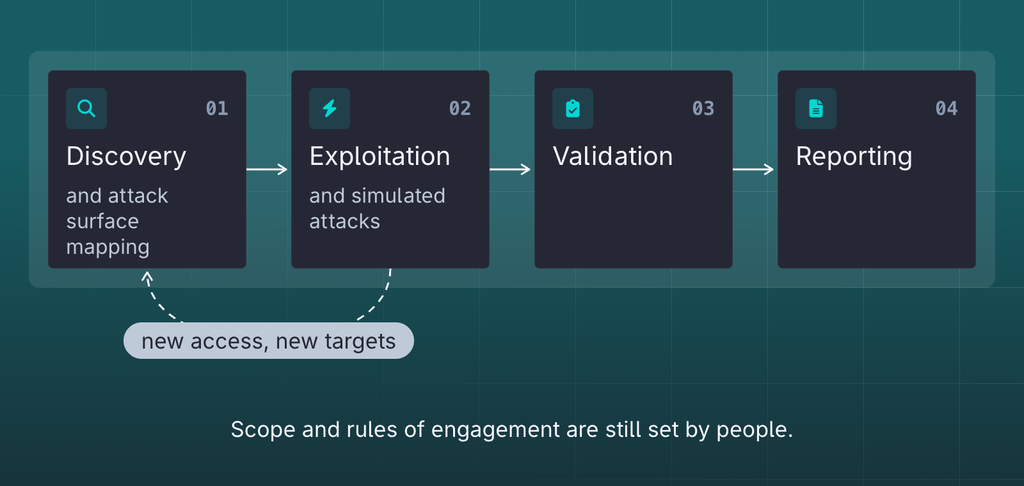
Caption: AI pentesting moves through discovery, exploitation, validation, and reporting, with new access feeding back into discovery.
Alt text: The four stages of AI penetration testing: discovery and attack surface mapping, exploitation, validation, and reporting, with exploitation feeding back into discovery.
Discovery and Attack Surface Mapping
Agents crawl the target, enumerate endpoints and parameters, and build a map of what’s reachable. When the tool gets source code or an OpenAPI spec, it can map routes a black-box crawl might miss, which is why some vendors ask for repository access up front. Unmapped endpoints may never be tested.
Exploitation and Simulated Attacks
This is where a pentest goes past finding individual flaws. Agents send real payloads, chain results, and change tactics based on how the application responds. For example, XBOW’s agents combine tools such as sqlmap and XSS tooling with LLM reasoning to choose and adapt their attacks. The attack and discovery phases feed into each other: gaining access can expose systems and resources that weren’t reachable before, giving the tester new targets to investigate.
Validation
Validation checks whether a suspected issue can be reproduced. In NIST’s model, identifying a possible vulnerability is different from confirming it through an exploit during the attack phase. AI vendors handle this step differently:
- Machine re-exploitation: Aikido uses a different set of agents to retry each exploit and excludes findings it cannot prove.
- Human confirmation: Synack’s flow ends with the Synack Red Team confirming exploitability before findings are delivered.
Ask vendors how they validate findings and what happens when the validator can’t reproduce one.
Reporting
The output is a findings report with reproduction steps, impact, and remediation guidance. In NIST’s model, reporting runs alongside the other phases rather than waiting until the end, and some AI tools let you watch the agents work live. A good report ties each finding to business impact, and some vendors offer retesting so you can confirm a fix after you ship it.
AI Penetration Testing vs. Traditional (Manual) Penetration Testing
Traditional pen testing puts a skilled human behind the key decisions. The work takes substantial human effort, and safely attacking the target requires expertise. That expertise is the strength and the bottleneck. AI pentesting trades some of that judgment for speed and repeatability, and how much it trades depends heavily on the vendor.
| Aspect | Traditional Pen Testing | AI Penetration Testing |
|---|---|---|
| Speed | Bounded by tester hours and scheduling | Hours to about a week, depending on scope and vendor |
| Cost | Scoped and priced per engagement | Varies widely; some vendors price by app size and complexity |
| Frequency | Usually tied to audits, major releases, or an annual cycle | On demand, and some vendors run continuously |
| Scope and coverage | Whatever is in scope, including social engineering or physical access if agreed | Commonly web apps, APIs, and external hosts; check limits such as MFA or internal network support |
| False-positive handling | Tester confirms by exploiting | Validator agents, human reviewers, or both |
| Business logic | Strong when the tester understands the business | Improving; intent-level flaws still benefit from human review |
| Compliance acceptance | The format most audit programs were built around | Depends on the vendor and your auditor; some produce SOC 2 or ISO 27001 formatted reports, others add human validation |
Scope limits are real and vendor-specific. Synack currently limits Sara to external web and host assets. It lists MFA and OTP support as planned, rather than available. Details like that decide whether a tool can reach your most sensitive flows.
Scope decides what gets tested. A pentest can include attacks on people and physical controls, such as social engineering, as well as technical exploits. A pentest scoped to your web app and APIs, AI-driven or not, won’t phone your help desk and ask for a password reset.
Two Things People Mean by “AI Penetration Testing”
Search results for this term split in a way that matters for buying decisions.
| Testing with AI | Testing of AI systems | |
|---|---|---|
| Target | Your regular web apps, APIs, and hosts | LLM features, machine learning models, RAG pipelines, and agents |
| Typical findings | SQL injection, XSS, broken access control, and IDOR | Prompt injection, system prompt leakage, data and model poisoning, and model inversion |
| Reference frameworks | NIST SP 800-115, PTES, and OWASP Top 10 | OWASP Top 10 for LLM Applications, MITRE ATLAS |
The first meaning is AI-powered pentesting of your own applications, covered above. Within it, ask whether a vendor is AI-assisted, with a human tester driving, or autonomous, with agents running the engagement. Both get sold under the same label.
The second meaning is penetration testing aimed at AI applications and models themselves, sometimes called AI red teaming. The OWASP Top 10 for LLM Applications lists the main risks. Prompt injection is first: input redirects the model’s behavior or output away from its intended task. The input doesn’t have to arrive in the chat box. A website or file the model reads can carry the instructions in an indirect prompt injection.
For attacks on the model and its data, MITRE ATLAS catalogs adversary techniques against AI-enabled systems. Two examples are training data poisoning (AML.T0020) and model inversion (AML.T0024.001), where an attacker may reconstruct training data by strategically querying an inference API and using its confidence scores.
A team may ship generative AI features without training a model: features that send user input to an LLM and act on the output. That part is application security, and you can test it at runtime the same way you test the rest of the app. We test for OWASP LLM Top 10 risks like prompt injection, system prompt leakage, and improper output handling as part of our existing DAST scans. That puts the LLM-integrated API under the same scans as the rest of the app, without a separate engagement.
Model-level threats like data poisoning or model inversion are a job for AI security specialists who work from MITRE ATLAS.
Benefits and Limitations of AI-Powered Penetration Testing
The benefits are mostly about cadence and coverage.
- More tests per year. Without a booked team, you can test before a big release instead of after.
- Validated findings. Good tools try to prove exploitability before reporting, which cuts false positives and gives reviewers reproducible evidence.
- Repeatable retests. Some vendors bundle retesting, so confirming a fix doesn’t mean a new engagement.
The limitations are mostly about context and reach. Business logic is the obvious one. XBOW retains a role for human testers to interpret results using their understanding of the business and its logic. An agent can find that /api/orders/1025 returns someone else’s order, but deciding whether a discount stacking bug is a flaw or a promotion takes someone who knows the business.
Authentication is the other wall. If an agent can’t get past MFA, it can’t test the protected paths, however capable the model is.
There’s also a timing gap. If testing waits for a release deployment, developers don’t get security feedback while they’re still working on the feature. Running tests earlier in the coding session gives them a chance to fix issues before opening a pull request.
Where AI Penetration Testing Fits With Continuous DAST
AI pentesting asks how exposed your running systems are. Continuous runtime testing asks something narrower: did the change you’re about to ship introduce something exploitable? AI pen testing and DAST test at different moments for different reasons. The second layer has also moved closer to where code gets written, which is how StackHawk fits into the AI coding agent loop.
Our agent skills teach coding agents like Claude Code, Cursor, Codex, GitHub Copilot, and Antigravity to run security scans, parse findings, fix vulnerabilities, and rescan to verify the fixes. When the agent finishes a feature, Wingman starts the app locally and hits it with real HTTP requests. The fix lands in the working tree as a normal git diff before any PR exists.
From June through September 13, 2026, Wingman fixed more than 7,500 vulnerabilities for early-access customers, including exploit-confirmed RCE, SQL injection, and XSS.
The same platform runs automated API security testing in CI/CD across REST, GraphQL, gRPC, and SOAP, flagging new API vulnerabilities on each pull request. None of this is a pentest. The agent workflow needs a running app and its source code, and runtime DAST isn’t built to chain a misconfigured cloud role into lateral movement. Use it to catch and retest known-class flaws before the next pentest.
How to Decide Between AI Pentesting, DAST, and Manual Testing
Start from the question, not the tool category:
- “Did this change ship an exploitable bug?” Use runtime testing in the coding loop or CI on every change.
- “How exposed is our deployed environment?” Use AI penetration testing on a schedule or continuously, depending on the vendor’s model. If you’re shortlisting vendors, compare the leading AI pentesting vendors on scope, autonomy, and validation.
- “Can a skilled attacker abuse our business logic, people, or process?” Use a human-led pentest, especially for high-assurance systems and audit requirements your auditor won’t accept from automation alone.
- “Can someone manipulate our LLM features or models?” Test LLM-integrated APIs at runtime, and bring in AI red teaming for model-level threats mapped to MITRE ATLAS.
You don’t need four separate tools, since one platform or engagement can answer more than one of these. The mistake is expecting any one of them to cover all four.
Conclusion
AI penetration testing makes real attack simulation easier to run and repeat, and the better tools prove each finding before they report it. It doesn’t remove the need for human testers on business logic, and a test against a deployed app can’t see code that’s still in a coding agent’s session. Treat it as one layer: AI pentests for depth on what’s deployed, runtime testing in the agent loop for every change, and people for the problems that need judgment.
If you want to see how continuous testing fits between your AI pentests, book a StackHawk demo. If you’d rather try it in your own coding agent first, Wingman has a 14-day free trial, then costs $10 per user per month.
FAQ
Not wholesale. AI is absorbing the repetitive parts of a pentest, like recon, payload iteration, and report drafting, but business logic and judgment about risk still need people. Human testers contribute business context to autonomous testing.
It’s a pentest where a human tester stays in charge and uses AI to speed up recon, suggest next steps, or draft reports. Autonomous AI pentesting goes further: agents run the engagement, and humans review the results, if at all.
There’s no single best tool, because products differ in scope (web apps, APIs, hosts, and internal networks), autonomy, and how findings get validated. Match the tool to your attack surface, then pilot it against an app whose weak spots you already know.
The Penetration Testing Execution Standard (PTES) defines seven: pre-engagement interactions, intelligence gathering, threat modeling, vulnerability analysis, exploitation, post-exploitation, and reporting. NIST SP 800-115 groups similar work into four phases.