A note before we start: yes, I’m in sales. I know how that sentence usually ends for you. Stay with me anyway. This one is about your Jira queue, and specifically about the code you’ve been shipping with an AI coding assistant, because that’s the code most likely to come back for you.
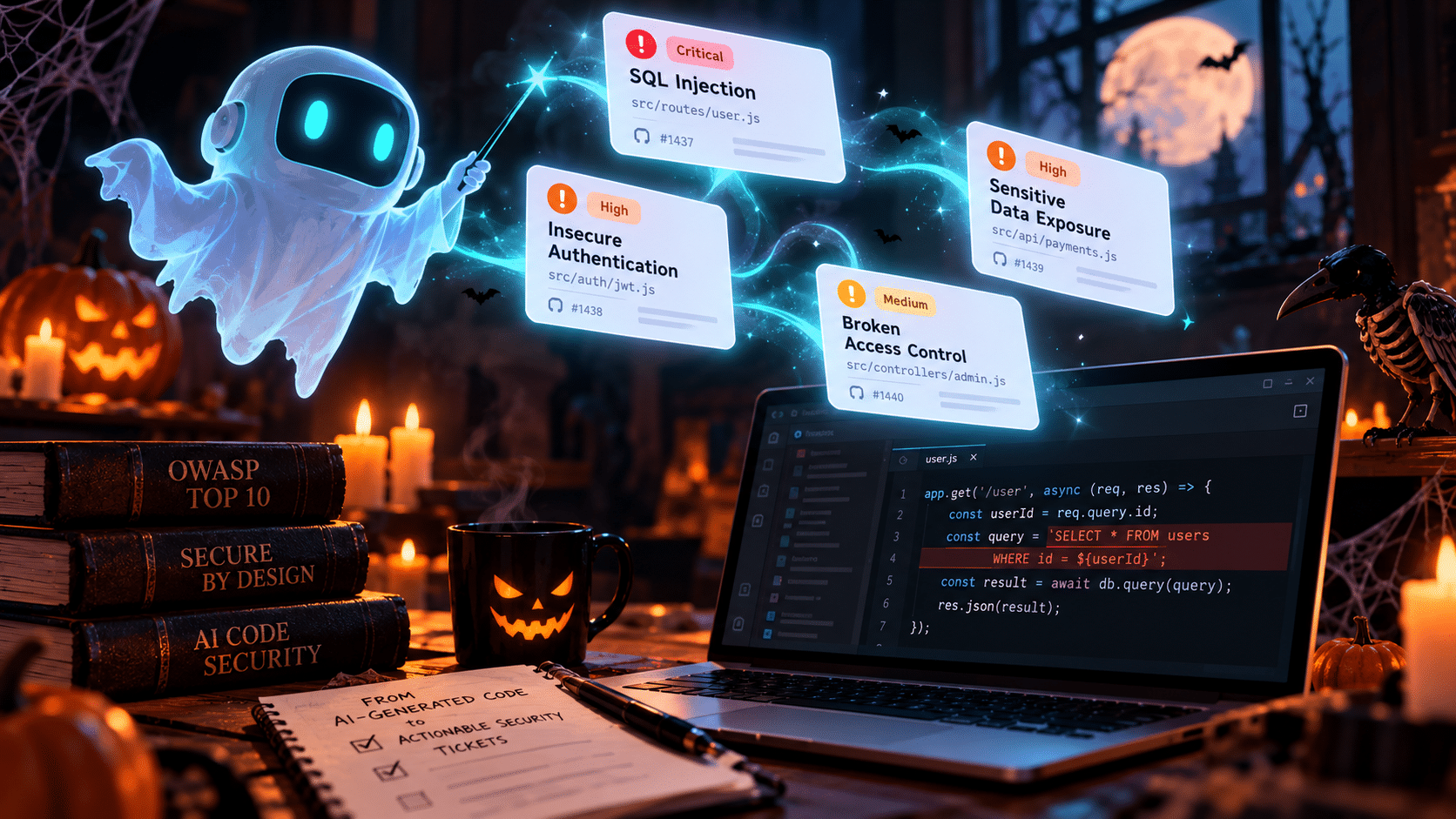
You’re mid-flow. Feature’s done, tests are green, you’re one PR away from actually seeing daylight. Then a Slack notification walks through the wall: a ticket titled “[URGENT] [AppSec-VULN-2026-108] Critical Data Leak”, filed against code your AI assistant helped you write three sprints ago, back when you still remembered what that endpoint did, let alone what the agent decided to do with it.
Congratulations. You’ve been haunted by your own commit history, generated at machine speed and reviewed at human speed.
Nobody enjoys this séance, including AppSec. They didn’t sign up to summon your old code back from the grave every two weeks. But it’s what the old tooling gives everyone: it scans, it waits, and after what feels like an eternity, a skeleton falls out of the closet with your name on the blame line.
It doesn’t have to work like this. The fix is probably the thing you’re most suspicious of: letting an agent hunt for security problems in your code in real time, right next to the tools already helping you write it.
What Is an Agentic Security Scan?
Here’s the plain version, no ghosts. An agentic security scan boots your running application, sends it real requests the way an attacker would, and works out which vulnerabilities are actually exploitable rather than theoretically present. When it finds one, it writes a fix using the patterns already in your codebase, then runs the scan again against the patched app to prove the vulnerability is gone. All of that happens before your pull request opens. That’s Wingman.
What Changed: AI Coding Agents Can Now Test the Running App
A year ago, “an agent fixes your vulnerability” mostly meant a chatbot suggesting a snippet that looked plausible and had never once been run against your application. Like a low-budget ghost hunter waving an EMF meter at your codebase and shrugging. It couldn’t discover your APIs or boot your service, so it was guessing.
Today the sequence is specific and, frankly, boring. The agent boots your app, sends real HTTP requests to find what’s genuinely exploitable, confirms the finding reproduces, writes the fix in the style of the code around it, and re-scans the patched app to show you the vulnerability is gone.
What changed is verification. The agent can check its own work against a running system, which is the only proof worth anything here.
Human Over the Loop, Not Human In the Loop
Your AppSec team isn’t vanishing into the mist, and you’re not turning into their ghost-hunting apprentice either. They move from personally investigating every bump in the night to setting the rules the whole house has to hold, AI-generated code included.
You gave up the how. You kept the is it actually gone?
Day to day, that means no ticket rises from the grave for something that was found and fixed before it ever became a “finding” in your world, no archaeology dig into a commit your assistant generated three sprints back, and no arguing in a PR comment about whether this one is a real threat or just the house settling.
The agent works inside whatever your team set: approve mode if you want eyes on every fix before it lands, auto mode if you’d rather let it apply fixes and review the diff.
One thing worth pulling out of the fine print: scan traffic never leaves your machine. The agent is talking to your app locally, and nothing about your code goes wandering off into the night. You can pull the full record of what it found and what it changed whenever you want it.
The only thing that actually disappears is the part where a ghost of code you don’t remember writing, reviewing, or fully understanding at 2 a.m. shows up demanding you deal with it mid-sprint.
Fewer skeletons, faster ships. Try Wingman free for 14 days. No credit card, no séance required, and no follow-up call from me unless you ask for one.
An agentic security scan runs inside your AI coding agent’s session. It boots your running application, sends it real requests the way an attacker would, and confirms which vulnerabilities are actually exploitable. When it finds one, the agent writes a fix using patterns already in your codebase and rescans the patched app to prove the vulnerability is gone, all before the pull request opens.
With a human in the loop, a person investigates and signs off on every step. With a human over the loop, sometimes called human on the loop, people set the rules the agent works within, such as which fixes need approval before they land, and review the record of what it found and changed. The agent does the routine work, and the team keeps control of policy and verification.
Traditional application security testing usually runs after code is merged. Findings wait for triage and then get filed against whoever last touched the code, often weeks later. AI coding assistants produce more code, faster, so more of those tickets land on code the developer didn’t write line by line and no longer remembers.
Yes. In approve mode you approve each edit before it lands. In auto mode the agent applies the fix and you review the diff. Either way, you can pull the full record of what was found and what changed.